
Articulate · Fair investigations · A life, against the case file
A man, eleven to twenty-eight — and the schedule that walked him there
Dateline · A kitchen table · Newcastle · May 2026
Cold open
Eleven. Pack of Match Attax. My dad used to bring his betting slip back from Ladbrokes — held it like it was glass. I held the pack the same way. Pulled a Limited Edition Rooney shiny holo. I knew what it was the second I saw it. You don't think about it. You just know.
Twenty-eight. Different kitchen. Phone face down on the table. Number on the screen: 87. I'd been clean nine weeks. Set my own block on GamStop. Gave my mum the password to my email so I couldn't undo it. Week ten I opened a new account. New operator. Offshore. They didn't check the name. £87 of the landlord's deposit refund, transferred at 02:47 on a Tuesday in March. Wasn't much. Doesn't have to be.
People keep telling me it was a choice. Fine. Then look at the operator. Tell me they didn't know.
Real addiction. No drug.
Gambling is real addiction. The same brain circuit that learns to want morphine — the mesolimbic dopamine system, worked through on the previous page — learns to want a Match Attax foil, a Sky Bet near-miss, a Polymarket close-call, a green NVDA candle at 02:47. The diagnosis stands.
What makes gambling distinctive on this site is that there is no drug. With alcohol, opioids, nicotine, food — the libertarian counter at least gets to argue the molecule did the work. Here there is no molecule. What the punter puts into his nervous system is a design — a trap built by a product team in an office, a lure dressed in the brand identity of the moment, a bait priced low enough that he can talk himself into it.
The trap doesn't change. Match Attax foils in 2009. FIFA Ultimate Team packs in 2012. CS:GO skin sites in 2015. DraftKings on the day after PASPA fell in 2018. Polymarket in 2024. A chatbot inside the app suggesting which 0DTE put to sell tonight, in 2026. Six products, six operators, one design. The lure changes brand identity. The bait keeps getting cheaper and more sophisticated.
Treating that as a willpower failure has been the policy default in every English-speaking jurisdiction for forty years. "When the fun stops, stop." "Take time to think." "Know your limits." Campaigns funded by the operators. Aimed at the punter, not the trap. The 2024 Lancet Public Health Commission, chaired by Heather Wardle, is the most thorough recent statement of the alternative: gambling is now a commercial determinant of health on the same shelf as tobacco and ultra-processed food, and the policy frame that pretends otherwise is itself part of the problem.
Mike at 11 · Newcastle · 2009
Match Attax. Same day my dad won £40 on a 40p acca and bought my mum carnations from the petrol station on the way home. Both happened. Both stuck.
Six months of buying packs. £4 a week pocket money. Supposed to be sweets. I didn't buy sweets. I bought packs. Most gave me cards I already had. One gave me a Limited Edition Rooney. I knew what it was the second my thumb touched the foil. Worth more than two quid. Way more. Wasn't pleasure I felt. Something in my chest went tight. The good kind of tight. I'd been right about something for the first time in my life.
I was eleven and I already knew what the pulse was. The trap had taught me.
The neuroscience on the next page says the dopamine pulse isn't pleasure. It's prediction. It's being right. The Rooney foil, my dad's 40p treble, the slot machine playing winner music when you've actually lost, the green NVDA candle at 02:47 — same pulse, every time. Eleven years old. I'd already learned it. Nobody at the corner shop made me read a leaflet first.
The pathway — variable-ratio reward and the machine zone
Mike's foil pulse is in the literature. Mesolimbic dopaminergic projection from VTA to nucleus accumbens. Kent Berridge's wanting/liking distinction — the wanting circuit fires for prediction, not for pleasure, which is why the gambler chases a reward they no longer enjoy. George Koob's allostasis — the set-point recalibrates downward, and the new baseline requires the activity to feel normal, not pleasurable. Nora Volkow's D2-receptor downregulation in pathological gamblers, structurally indistinguishable from the imaging in cocaine-dependent and food-addicted populations.
What makes gambling distinctive is the schedule, not the substance. B. F. Skinner's 1957 finding that variable-ratio reinforcement produces the highest extinction resistance of any reward schedule ever tested is the single most replicated result in operant conditioning. It is also the operating specification of every slot machine and every mobile-sportsbook in-play bet. The engineering is not incidental; it is the product. Natasha Dow Schüll's Addiction by Design (Princeton, 2012) is the fifteen-year ethnographic case file — the "machine zone," the dissociative flow state, the designers and behavioural-economics consultants whose job is to produce that state and prolong it.
The cost — global and asymmetric
The Lancet Public Health Commission on Gambling (Wardle et al., 2024) projects global consumer net losses to reach ~US$700 billion by 2028. US commercial gaming revenue hit $78.7bn in 2025; sports betting alone rose to $16.96bn (+22.8%) on a handle of $166.94bn. Roughly 1 in 5 sports bettors meet criteria for gambling-related harm. UK Gambling Commission data show the top 5% of customers by spend produce 60–80% of net operator revenue. That is not a bug in the business model. It is the business model. The economic structure of legal gambling at scale requires the industry's profitability to be load-bearing on a population of clinically dependent users — and operators know in real time, at the account level, which customers are in the dependent minority.
Mike at 18 · Newcastle · 2016
Everyone bet on the Grand National. I did too. Sky Bet push notification at 16:11. Nine-second video — a coin spinning, lands on £8.50. The amount I'd win on a bet I hadn't placed yet.
Won £42 on a tenner. Front room of a shared house in Heaton, mate's laptop. Felt the pulse again. Twice. First, that the notification had been picked for me. Second — already knew I'd put it all back in by midnight.
23:00 the £42 was £18. 01:00 it was nothing. 02:00 I'd moved £30 over from the overdraft.
Bed at four. Lecture at nine. Went. Took notes. Said nothing. By the end of that winter I was the friend in the group nobody bet with.
The spread — three engines
The post-2018 explosion of gambling availability is not one phenomenon. It is three engines firing in series, each one normalising the next.
Engine one — PASPA and the US mobile explosion. Murphy v. NCAA (May 2018) repealed the federal prohibition. By end-2024, 38 US states had operational legal sports betting; 30 authorised mobile-app betting, the high-engagement channel. DraftKings and FanDuel converted into full sportsbooks within twelve months. The UK, Australia and Italy had run the same arc a decade earlier; the US compressed it into five years. The peer-reviewed harm signal is now visible: Baker et al. (2024) find a ~28% increase in bankruptcy filings in the most-exposed demographic within four years of state legalisation.
Engine two — prediction markets. Polymarket and Kalshi operate "event contracts" that pay out on real-world outcomes — elections, championships, rate decisions. Behaviourally indistinguishable from a binary sports bet. The 2024 Kalshi v. CFTC ruling held they are not "gaming" under federal law. State regulators have lost in federal court; Minnesota became the first state to criminalise prediction-market hosting in May 2026. The federalism battle is unresolved. The behavioural question is not. Whether or not these are gambling for the Commodity Exchange Act, they are gambling for the brain.
Engine three — the kid pipeline. Loot boxes (Zendle, Drummond, Cairns, Hall — five replicated studies, 2019–2024) produce a stable association with Problem Gambling Severity Index scores. Mystery-box TikTok streamers (Stake.com-sponsored, hundreds of millions paid to surface conversion paths to crypto-casino accounts). Then: zero-commission options trading. Robinhood, Webull, Public.com — confetti animations, streak rewards, push notifications on volatility, gamified onboarding for 0DTE options and leveraged ETFs. The pipeline is not a metaphor. It is a sequence the affected population walks through in calendar order, each step engineered by the same behavioural-economics consultancies. The kid opening a Match Attax pack and the man closing a losing 0DTE put at twenty-two are running the same circuit.
The policy failure — the operator-funded responsibility shift
Forty years of "responsible gambling" policy follows the shape this site has documented across alcohol, opioids and food. Operator-funded campaigns. Aimed at the customer, not the product. Self-regulation language ("set a budget", "take a break") shifting moral responsibility for an engineered dependence from the operator who engineered it onto the consumer who is in the affective grip of the schedule. The evaluation evidence is consistent: responsible-gambling messaging has no measurable effect on population-level harm and a small reliable effect on the customer's feeling that they have been warned — which the operator can then cite as evidence that the customer is responsible for the outcome. The structural critique — Wardle's — is that this is not an accidental design choice. It is the dominant policy stance because the alternative would require regulators to confront the industry's business model directly.
The guide — Rob Davies, on the Walworth Road
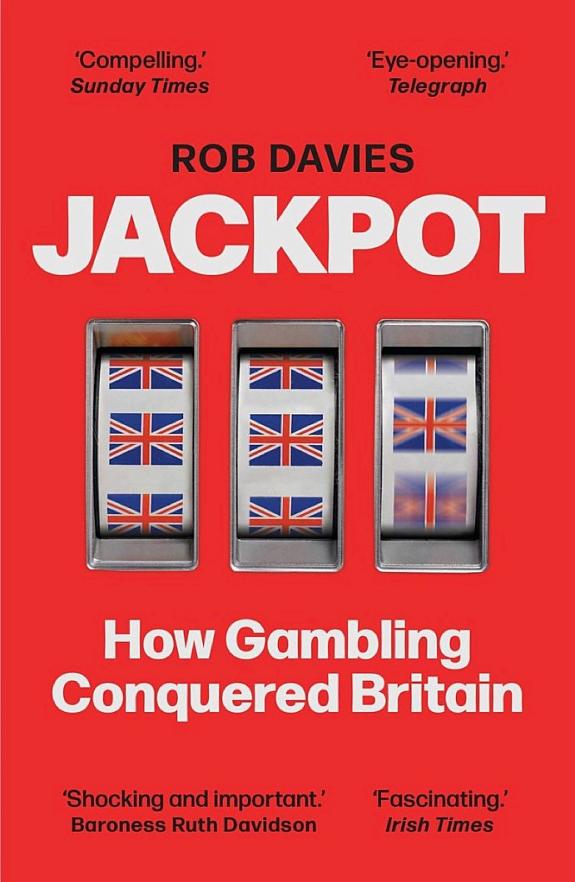
Investigative reporter, The Guardian. Six-year beat on the British gambling industry. British Journalism Award (2019). The Walworth Road in south London — three doors of William Hill, Betfred, Ladbrokes — was the original field for his reporting. He has sat with the parents.
I've heard the desperation in the voice of someone who has lost hundreds of thousands of pounds in a matter of weeks, and I've sat with the parents of young people who had their whole lives ahead of them, until a gambling addiction drove them to suicide.
— Rob Davies, Jackpot (Guardian Faber, 2022)
What Davies saw is not what the policy papers describe. He saw scorecast bets engineered to look like routine Saturday-afternoon predictions while the bookmaker's true odds were a fraction of the displayed price. He saw "dark nudges" — Newall's phrase, borrowed from Thaler and Sunstein — designed to push the punter toward complex markets where the operator's informational asymmetry was maximised. He saw losses dressed in winning music, near-misses engineered to fire the gambler's neurological circuitry into another spin. He saw a regulator decline to act for a decade. The 2023 White Paper — which his reporting forced into legislative motion — was, when it finally arrived, a settlement with the engineering rather than a confrontation with it.
The polemical move Davies makes is to refuse the "responsible gambling" frame on its own terms. Asking the punter to gamble responsibly when the product was engineered against responsible use is not regulation; it is moral cover. The Guardian extract from Jackpot is the load-bearing single piece of his work on this page's argument.
The trap, ten brand identities · 2009 → 2026








Two UK high-street books · two UK / EU online operators · two US post-PASPA sportsbooks · one crypto casino · two prediction markets · one gamified retail brokerage. One reinforcement design. Hover for colour.
Mike at 26 · the call to his mother
Thursday. Rang my mum. She'd done the GamStop registration with me the year before — they need a named contact. I gave her my email password and asked her to do it. She did. Didn't say much. Did ask what happens if I change the password back. I said I won't. Meant it.
Ten months later I'm ringing her to say I've opened an account under a different spelling of my surname. Offshore operator. Their KYC matches loose. Bet was £87. Lost. The £87 was my landlord's deposit refund. Arrived three days before.
She didn't cry. Listened. Said I had to ring the counsellor before I rang her again.
Rang him that morning. He said what they say. Relapse is part of the recovery. The £87's sunk. The question is what I do at 02:47 the next time the new operator's notification hits. Next night it hit at 02:47. I didn't bet. Can't tell you why.
This is where Snowdon's going to tell you it's voluntary loss between consenting adults. I'd like a word with him.
The Snowdon counter — voluntary loss between consenting adults
The libertarian counter-thesis to the Lancet position is articulated most cleanly by Christopher Snowdon and the Institute of Economic Affairs. Snowdon has four moves: gambling losses are voluntary transfers between consenting adults; harm estimates rely on contested clinical thresholds; aggregate "consumer loss" figures ignore that operator profits accrue to shareholders, regulators, and tax revenue; prohibition or heavy regulation drives the activity offshore where harm is higher.
Each move is partly right and partly evasive. Voluntary-transfer logic is defensible for a population that is not in the grip of variable-ratio operant conditioning — and it is the editorial register much of this site defaults to on alcohol and recreational drugs. It is harder to defend in a literature where 60–80% of operator revenue comes from clinically dependent customers and the operator can see in real time which of its customers are in that minority. The contested-criteria move is the most empirically honest of his arguments — DSM-5 cut-offs are not bright lines — but even at the conservative end of defensible prevalence, the dose-response curve to operator-engineered availability is steep. The offshore-prohibition move is his strongest, and the one this page concedes: the post-PASPA US case is not an argument for prohibition; it is an argument that the bring-it-into-the-light strategy on online gambling has not delivered the consumer protections its proponents promised. The product available legally in 38 US states in 2026 is closer to the offshore operator of 2017 than to a regulated public-health-mode product.
The honest synthesis is the one the rest of this site has been arguing on every class of substance: the disease frame and the structural frame are both correct, and the willpower frame is the failure mode that lets the operator off the hook.
Mike answers Snowdon
Snowdon says voluntary loss between consenting adults.
I consented to the first £20.
I didn't consent to the next four years.
The product was built to turn the first £20 into the next four years. The "responsible gambling" campaign was paid for by the people who built it. The regulator didn't act because the law treats the next four years as my problem and the design as a private matter between operators and shareholders.
People say I should have known. I knew. Eleven, I knew. Eighteen, I had the receipts. The question isn't what I knew. The question is whether anyone was going to act on the fact that the trap was built to walk over what I knew. Nobody did. The line that says they didn't have to is the line my mum was reading on the back of the betting slip in 2009. It's the line Schüll watched the engineers writing in 1998. It's the line Davies has been printing in the Guardian since 2019.
Twenty-eight. Fourteen months without a bet. People ask if I won. I don't call it that.
A note on Mike. Mike's voice in this page is a composite drawn from the published accounts of Phil Worrall (interviewed by Rob Davies in the Guardian extract from Jackpot, 2022), Chris Murphy (at the Sporting Chance clinic), James Grimes (The Big Step), and Patrick Foster (BBC Sounds, GambleCheck; Might Bite, Bloomsbury, 2022). The detail of place, the family circumstance, and the dialogue are constructed; the texture and the chronology track the lived experiences these named voices have published on the record. This is the literary convention narrative journalism has used since Capote and Talese. It is declared here so the reader can carry the disclosure forward.
Discussion
Comparing v1 (analytical) and v2 (magazine-feature)? Annotate either with Hypothesis — highlight any line. Public thread below via Giscus.